PAINTINGS
AJANTA
CAVE PAINTINGS
the many-splendoured delights of Ajanta compiled by Subramanian Swaminathan
e-mail: sswami99@gmail.com
September 2007
Painting Technique
Indian wall-paintings are done on
dry wall, called fresco secco.
In the West painting is done on a
moist wall, called fresco buono.
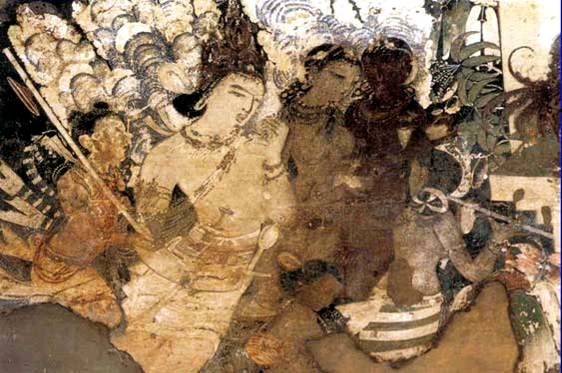
Indra's Descent, Cave 17
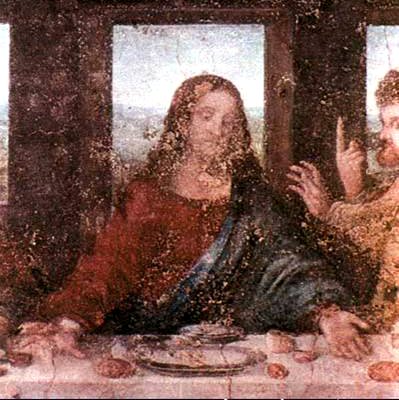
Last Supper, da Vinci
It might have taken centuries for
the Indian artist to develop the technique of preparing the wall for painting,
and also to select suitable pigments with an appropriate binder.
The importance of these may be seen from the fact that the Ajanta paintings
have withstood the ravages of time with remarkable resilience.
Preparation of Wall
We have no clue to the technique
of preparing the wall. But the treatises which were written later
based on the Ajanta experience give us an idea. For example, Vishnu-dharmottara
(7th century) explains the process of preparing the base plaster and the
finish coat, called 'vajralepa'.
Preparation of Wall - Base Plaster
The base plaster consisted of powdered
brick, burnt conches and sand, mixed with a preparation of molasses and
drops of a decoction of Phaseolus munga. To this were added mashed
ripe bananas or tree resins and the pulp of bilva fruit (Aegle marmelos).
After drying it was ground down and mixed with molasses and water until
became soft for coating.
Preparation of Wall - Finish Coat
(Vajralepa)
Buffaloskin was boiled in water
until it became soft. Sticks were then made of the paste and dried
in the sunshine.
When colour was mixed with this,
it made it fast, and if white mud was mixed with it, it served as a perfect
medium for coating walls.
Pigments used
Most pigments were minerals available
locally: red ochre, vivid red, yellow ochre, indigo blue, chalk white,
terra verte and green.
Only Lapis lazuli was imported.
Lamp-black was the only non-mineral.
Painting Sequence
A preliminary sketch in iron ore
was drawn while the surface was still slightly wet, followed by an under-painting
in grey or white.
On this surface the outline was
filled in with various colours, proceeding from underpainting to the appropriate
colours of the subject.
Finally, when dry, it was finished
off with a dark outline for final definition and a burnishing process to
give lustre to the surface.
Painting Tradition
The paintings of Ajanta are the
earliest representation of Indian painting tradition available to us.
Even the earlier paintings at Ajanta,
of the 2nd century BC, demonstrate a sophisticated technique, achievable
only after centuries of experimentation.
Unfortunately we have no trace of such experimentation.
To get to know this great tradition
one may turn to the treatises written based on the Ajanta experiment.
Treatises were codified based
on Ajanta experience
Brihat-samhita (6th century)
Kama-sutra (6th century)
Vishnu-dharmottara (7th century)
Samarangana-sutra-dhara (11th century)
'Six Limbs of Painting' according
to Kama-sutra, a well-known treatise on erotics
Rupa-bheda - differentiation
Pramanam - proportion
bhava - suggestion of
action/mood
lavanya-yojanam - infusion
of grace
sadrisham - resemblance
varnika-bhangam - application
of colour
'Eight Limbs of Painting' according
to Samarangana-sutra-dhara, a treatise on Architecture
bhumi-bandhana - preparation
of surface
varnika - crayon work
rekha-karma - outline
work
lakshana - features
of face
varna-karma - colouring
vartanakarma - relief
by shading
lekhakarma - correction
dvika-karma - final
outline
Back
|