Hindu Temples
Yaganti Uma Maheshwara Temple
Kurnool district, Andhra Pradesh
Sri Yaganti Uma Maheshwara temple dedicated to Lord Shiva and
Parvathi is located in the Yerramala hills, Nandyal district of Andhra
Pradesh near Banaganipalli in Kurnool district.
Unique features of the temple:
- Along with the customary Siva Linga, the main deity in this temple is in the form Ardhanareeswara (Lord Siva &
Goddess Parvathi in one form).
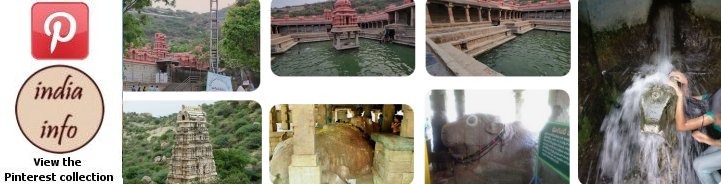
- The Nandi idol (Siva's vahana, the bull) is said to be growing in
size, at the rate of one inch every 20 years (sources say it is
confirmed by the Archaeological Survey of India). Experts opine that the
Nandi has been carved out of a rock which has the natural ability to
enlarge.
Size: five feet high and 15 feet wide
Mines and Geology department assistant director C. Mohan Rao from
Elur said that stones grow due to chemical reactions. "The rock has
silica substances and iron particles. When a mineral is converted to
other granules of Silica, it expands."
Former Pathapadu sarpanch Chandrasekhar Reddy, whose family has been
regular devotees for centuries, said, "There was a space to do
pradakshinas (rounds) around Basavanna a century ago, but now it has
taken up the gap between the stone pillar."
- Tourist attraction: Kurnool
Nandi idol slowly 'growing' by Hoskote Nagabhushanam, Deccan Chronicle, May 1, 2016) |
- The water in the temple tank remains at a steady level throughout the
year. It is fed by 5 springs that spout from beneath the Siva
Lingam through the mouth of a Nandi. The skilled Viswakarma
Sthapathis have achieved this marvel, the origin and route of the water
flow has not yet been figured out.
- There are no crows to be seen in the vicinity and since the crow is
the vahana of Lord Saneeswara, devotees are protected from his vision in
this temple premises.
Legends: Sage Agastya wished to build a temple for Lord Vishnu, but could not
install the deity, since it was disfigured with a broken toe nail.
Lord Siva appeared before the sage and informed him that the location
was better suited for a Saivaite temple. On the request of the
sage, Lord Siva provided an idol of Ardhanareeswara carved out of a single stone.
It is believed that a sage (Agastyar or another saint) who was disturbed
in his meditation by the cawing of crows, cursed them not to enter this
peaceful area.
Another legend associated with the temple is that an ardent devotee by
name Chitteppa was granted the vision of Lord Siva. The Lord is
said to have appeared in fornt of him in the form of a tiger, but
Chitteppa instead of feeling fear, dance with joy for he realised that
it was the Lord himself who had given him darshan. There is cave near
the temple called the Chitteppa cave.
There are several other caves around the temple. In the Agastya
cave is seen an idol of the Goddess and the Venkateswara cave with
a steep rise houses the disfigured idol of Lord Venkateswara which could not be
installed. Potuluri Veera
Brahmam, popularly known as India’s Nostradamus, author of Kala Gnanam, the book of prophecies is siad to have meditated in the Veera Brahman Cave. One of predictions is that the growing Nandi will come alive and shout when Kali Yuga ends.
History: Built according to the Vaishnavaite traditions, the
temple was constructed by King Harihara Bukka Raya of the Sangama
Dynasty of the Vijayanagara Empire in the 15th century.
Ashtalakshmi temple, Besant Nagar, Chennai
Potuluru Veerabrahmendra Swami was a Hindu sage and oracle. He is
considered to be the author of the Kalagnanam (Kaala gnyaanam), a book of predictions
about the future. His prophetic texts are also known as the Govinda
Vakyas. He also wrote Jeevaikya Bodha. Vīrabrahmēndra's birth date and
lifespan are unknown. Conflicting theories hold that he was born either
in the ninth century (in order to accommodate predictions written in the
Kālaṅñānaṁ about the fall of dynasties during the ninth century) or in
the seventeenth century. According to legend, Veerabrahmam was born to a
religious couple Paripurnayacharya and Prakruthamba, who belonged to a
vishwabrahmin / vishwakarma / Acharya family near the river Sarasvati
River in the village of Brahmandapuram. The couple abandoned Swamy at
birth and Veerambrahmam was brought up at Atri Mahamuni Ashram near
Kashi (present-day Varanasi). Later Veerabhojayacharya, Head of the
Papagni Mutt, Chikballapur, Karnataka, was on a pilgrimage with his
wife. The couple visited the Sage Atri Ashram, and Sage Atri gave the
child to the couple.
Source: A brief History of Kalagnanam written by Sri Veera
Brahmendra Swamy Paperback - Import, 11 June 2019 by Dr P Thiripalu
(Author), Smt A Padmalatha (Author), Dr Morusu Sivasankar (Author),
amazon.in |
|