Snippets of Information
Achievements / Recognition - Science / Medicine
* 19 Jul 2026
Homi Bhabha Centre for Science Education, a National Centre of the Tata
Institute of Fundamental Research, an Aided Institution under the
Department of Atomic Energy, continues to nurture India's brightest
scientific talent through the National Olympiad Programme.
In 2026, the Indian team secured historic results at several major international science Olympiads, achieving multiple gold medals and joint top-ranking positions.
At the 56th International Physics Olympiad (IPhO) held in
Bucaramanga, Colombia, India achieved a clean sweep, securing the World No. 1 rank, jointly with China,
Kazakhstan, Russia, South Korea and Taiwan, among 381 students from 87
countries. The Indian medal winners - Kanishk Jain (Pune,
Maharashtra), Riddhesh Anant Bendale (Indore, Madhya Pradesh), Rishit
Garg (Dwarka, New Delhi), Shresth Suraiya (Mumbai, Maharashtra), Svarit
Joshi (Ahmedabad, Gujarat).
At the 58th International Chemistry Olympiad (IChO) in Tashkent, Uzbekistan, India again secured joint Rank 1 with China, Vietnam, and an individual from Russia.
Debadatta Priyadarshi (Bhubaneshwar, Odisha), Harshit Singla (Mandi Gobindgarh, Punjab), Kabeer Chillar (Delhi), Sandeep Kuchi (Hyderabad, Telangana).
This was the 27th appearance of India at the IChO. In all these years,
32% of Indian students have got gold medals, 51% silver, and 17% bronze. In
the last ten appearances, the percentages of gold and silver medals
have been 43% and 53%, respectively.
Source: pib.gov.in
India has won one gold and three silver medals at the 37th International Biology Olympiad (IBO) 2026 held in Vilnius, Lithuania. Bhavyaa Gunwal from Haryana won the gold medal while Soumil Maity from West Bengal, Nishit Kalani from Rajasthan and Anmol Kumar from Punjab won silver medals.
This was India's 26th appearance at the IBO and of the 104 students so
far, 17 have received gold medals, 69 silver, 17 bronze, and 1
honourable mention.
Source: newsonair.gov.in
* 4 Feb 2026
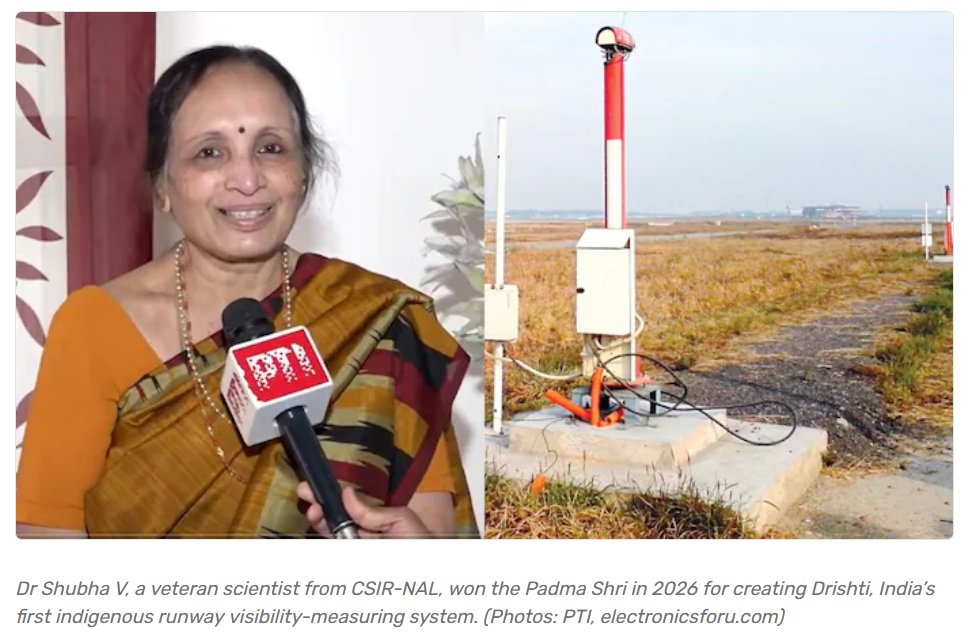
Image Source: indiatoday.in
Dr Shubha V, a veteran scientist from CSIR-NAL, won the Padma Shri in 2026 for creating Drishti, India's first indigenous runway visibility-measuring system.
Installed at major airports since 2011, Drishti provides critical
visibility data to pilots and controllers, strengthening aviation safety
and reducing reliance on costly foreign instruments.
For years, many airports in India relied on imported instruments to
measure runway visibility - vital data that tells pilots how far ahead
they can see during landings and take-offs. This parameter, known as
Runway Visual Range (RVR), is a key safety metric in aviation,
especially in poor weather conditions. Drishti has been operational for
more than a decade. Field installations for trials date back to 2011 at
Indira Gandhi International Airport in Delhi. It was subsequently
expanded to Kolkata and Lucknow, and has since been installed at major
airports nationwide.
At a basic level, Drishti helps pilots make informed decisions during
critical landing and take-off phases. It measures the clarity of the air
along the runway and provides real-time data on visibility. Drishti
uses a transmissometer system that continuously measures how much light
travels between two points near the runway, giving a precise runway
visual range (RVR). It operates in real time and communicates data back
to air traffic control and meteorological officers. Drishti is also
designed for Indian conditions, and operates continuously, capturing low
visibility changes that can occur rapidly at dawn or dusk, moments when
accidents are more likely.
Source: Meet Padma Shri Shubha V Iyengar, the scientist behind
India's aviation safety tech by Roshni Chakrabarty, India Today
Education Desk, New Delhi, 28 Jan 2026
* 4 Feb 2026
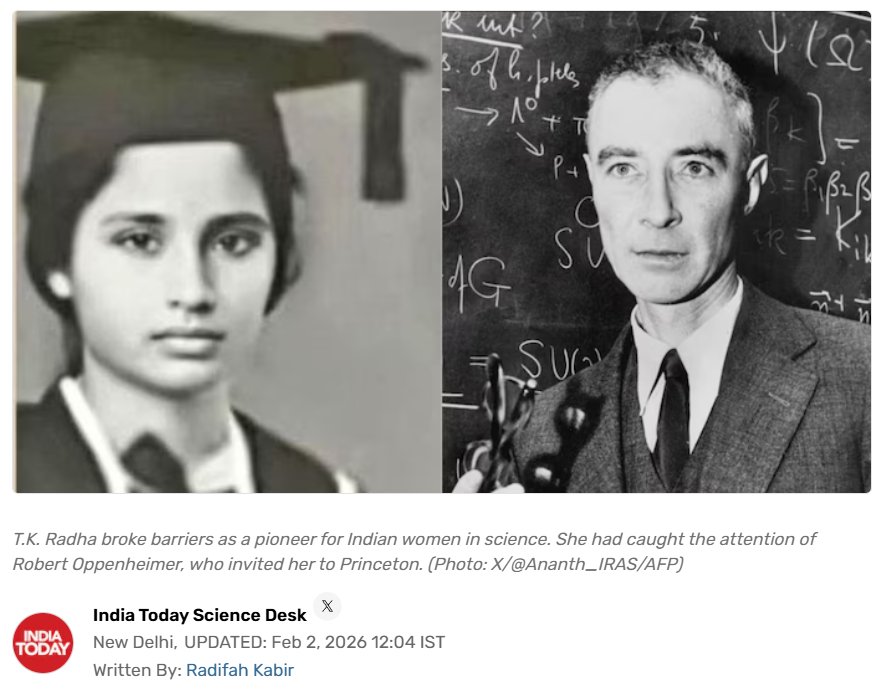
Image Source: indiatoday.in
TK Radha was an Indian physicist from Kerala who studied at
Presidency College in Madras. She was an academic star, earning a gold
medal for her excellence in physics. She joined the research group of
Alladi Ramakrishnan, a legendary figure in Indian science.
Radha arrived at Princeton to conduct research in September 1965 at a personal invitation
from J. Robert Oppenheimer (Director of the Institute for Advanced Study
in Princeton), the visionary physicist known as the father of the
atomic bomb.
Radha's expertise was in particle physics, a field that seeks to
understand the smallest building blocks of the universe. She wrote 14
papers explaining how these particles interact. She specifically focused
on "Regge poles". a theory describing how particles scatter when they
hit each other at high energy. Her work delved into the complex
mathematical symmetry of particles, helping scientists understand how
they exchange properties during a collision. She continued her learning
even after moving later to Canada.
Source: Who was TK Radha? Indian woman scientist who became
Oppenheimer's chosen genius by Radifah Kabir, India Today, 2 Feb 2026
* 16 Jan 2026
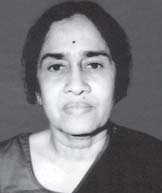
Image Source: ias.ac.in
Kamala Sohonie was the first Indian woman on whom the title of PhD degree was conferred
Her father Narayanrao Bhagwat and his brother Madhavrao were
distinguished chemists and were among the first to pass out from (Tata)
Institute of Science, Bangalore. Inspired by them and wanting to follow
in their footsteps, Kamala applied to Indian Institute of Science
(IISc), Bangalore after passing her B.Sc (physics and chemistry) from
Bombay University and having stood first (in first class) in that
exam. But she was denied admission by the director of the
institute, Sir C.V. Raman, Nobel Laureate on the ground of her
gender. In those days in 1933, women were expected to stay
confined to domestic life. She would not give up and as a firm
believer in Mahatma Gandhi, she decided to do satyagraha in Sir Raman’s
office, till she was admitted. Prof. Raman granted her admission on
condition that for one full year she would be on probation and also that
her presence did not distract his male researchers from their work.
Kamala accepted these terms and she worked very hard under her teacher,
Shri Sreenivasayya. Satisfied and impressed by her sinceirty and
dedication, Sir Raman allowed her to do regular research in Bio-chemistry at Indian Institute of Science (IISc), Bangalore.
He was impressed enough to admit lady students to the institute from
then on. She thus opened the doors for other women students too. Here
she worked on proteins in milk, pulses and legumes. In 1936, Kamala,
then only a graduate student, was the first person to work on pulse
proteins. She submitted her research to Bombay University and received
her MSc degree. She then went to Cambridge University and first worked
in the laboratory of Dr Derik Richter and later under Dr Robin Hill, who
was doing similar work, but on plant tissue.
Kamala sent a short thesis describing her finding of cytochrome C in
respiration of plant tissue, to Cambridge University for her PhD degree.
Her PhD degree is remarkable in many ways. Her research and writing of
the thesis was done in less than 14 months since arriving at Cambridge.
It consisted only of 40 type written pages. She was the first Indian woman on whom the title of PhD degree was conferred. She was keen on returning to India, and started work at Lady Hardinage College, New Delhi, 1939 as professor and head of the newly opened Department of Bio-chemistry. Later she was Assistant Director of the Nutrition Research Lab, Coonoor. There she conducted important research on the effect of vitamins.
She married M.V.Sohonie, an actuary by profession and moved to Mumbai in
1947. During her tenure at the Royal Institute as Professor of
Bio-chemistry in the newly opened Bio-
chemistry Department, she worked with her students on nutritional
aspects of Neera, pulse and legume proteins as well as Dhan (paddy)
atta. All the subjects of her research were very much of relevance to
Indian Societal needs. In fact, her work on Neera was started on a
suggestion from the then Rashtrapati Dr Rajendra Prasad.
Her work conducted by her students showed that introduction of Neera in
the diet of tribal malnourished adolescent children and pregnant women,
caused significant improvement in their overall health. She made her
students (different batches) do this work on samples of neera taken from
all over the country. They worked for 10-12 years and always got the
same results. Kamala Sohonie received the Rashtrapati Award for this work.
When finally she was given the post as Director of the Institute of Science, Bombay,
Dr Derik Richter, her first guide at Cambridge, remarked that "she made
history by being the first lady Director of such a big science
institute." Kamala Sohonie passed away in 1998.
Source: The scientist lady Kamala Sohonie by Vasumati Dhuru, ias.ac.in
* 1 Jan 2026
First indian woman doctor - Dr. Anandibai Joshi (1865 - 1887)
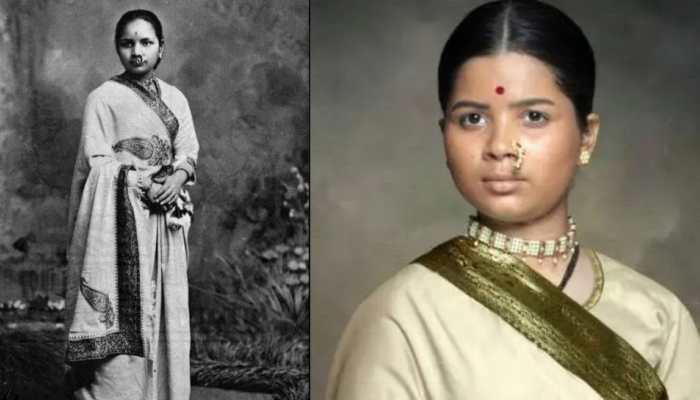
Image Source: Zee News
Dr. Anandibai Joshi was the first Indian female physician to complete
her studies in Western medicine at the Women's Medical College of
Pennsylvania. A pioneer in medicine, she was a trailblazing Indian
woman, who had faced many hurdles during her quest for education. In her
short span of life, she faced a lot of emotional, mental, physical, and
social turbulence and had to prove herself at every step to the
orthodox patriarchal Indian society the need to study medicine. As
childhood marriage was a common practice in India during the 19th
century, Anandibai was married to Gopalrao Joshi when she was only 9
years old, who renamed her "Anandi." With an encouraging father during
her childhood and a supportive husband after marriage, she could pave
the way for herself in the orthodox Indian society, dominated by males.
When she was 14 years old she delivered a baby boy who could not survive beyond 10 days due to
lack of medical care. This was the turning point in her life, and she
was determined to become a physician so that the other women would not
suffer the way she had.
Strongly supporting his wife, Gopalrao wrote a letter to Royal Wilder,
an American missionary, to help Anandibai Joshi study medicine in the
United States. Wilder published the letter in Princeton's Missionary
Review. This letter was read by Theodicia Carpenter, a resident of
Roselle, New Jersey, who was thoroughly impressed by Anandibai's
interest to pursue medicine and her husband's support for her to do the
same. For nearly two years, Theodicia and Anandibai exchanged their
views regarding religion, social, and cultural differences between the
two countries. During this period, Anandibai gained confidence in
self-expression in English. Theodicia was instrumental in convincing
Wilder, and Anandibai was lucky to get a chance to study medicine at the
Women's Medical College of Pennsylvania (WMCP), Philadelphia.
Dr. Anandibai's thesis titled "Obstetrics among Aryan Hindus" included
references from ancient Indian texts as well as from American medical
literature. She also received a letter from Queen Vitoria, the Empress
of India, congratulating her in recognition of the medical degree she received at the age of 19. Dr.
Anandibai Joshi returned to her home country where she was given a
warm-hearted welcome and greatly appreciated for her accomplishments in
1886.
She had been appointed as the physician-in-charge and was given
the responsibility of Edward Albert Memorial Hospital in Kolhapur.
However, she succumbed to tuberculosis at an early age on February 26,
1887, before becoming 22 years old. Despite her short life, Dr.
Anandibai Joshi inspired women throughout the country and is a pioneer
in Indian healthcare.
The Institute of Research and Documentation in Social Sciences (IRDS)
named the Anandibai Joshi Award for Medicine in honor of her significant
contribution. The Government of Maharashtra has a fellowship program in
her name to honor young females working on women's health.
Source: pmc.ncbi.nlm.nih.gov
|