PAINTINGS
KERALA MURALS
June 2009 - last updated April 2013
Indian-heritage collection on Pinterest
Articles
on the net
Kerala has a tradition
in the field of painting as is evidenced by the murals in temples, palaces
and churches. The murals of Tirunandikkara (now in Kanyakumari district)
and Tiruvanchikulam are reckoned as the earliest specimens of Kerala painting.
These have been assigned to the period from the 9th to the 12th century
A.D. Most of the murals now seen in Kerala temples belong to the period
from 15th century onwards.One can say that the tradition of painting on
walls began in Kerala with the pre-historic rock paintings found in the
Anjanad valley of Idukki district. Archaeologists presume that these paintings
belong to different periods from upper Paleolithic period to early historic
period. Rock engravings dating to the Mesolithic period have also been
discovered in two regions of Kerala, at Edakkal in Wayanad and at Perumkadavila
in Tiruvananthapuram district....
Archaeological evidences point to
the period from the mid-sixteenth century onwards as the most prolific
period of mural art of Kerala. Srikumara's Silparatna, a sixteenth century
sanskrit text on painting and related subjects must have been enormously
useful to contemporary and later artists. This treatise has been acclaimed
as a rare work on the techniques of Indian art, the like of which has not
been published before or after. It discusses all aspects of painting, aesthetic
as well as technical and it is greatly useful in understanding the later
medieval murals of Kerala......
Source: http://www.keralamurals.com/
mural-paintings/murals-tradition.htm |
Pundareekapuram
Murals
What makes this temple so special
to the art lover, apart from the rare idol, are the exquisite paintings
on the walls of the sanctum. Eight large panels and about twenty smaller
ones feature episodes from the Hindu myths and the Puranas.
keralamurals.in/
pundareekapuram-murals |
Ettumanoor
Murals
Ettumanoor temple is also a museum
of rare and beautiful works of art and sculptures in wood and stone. The
walls of the central shrine or sanctum are paneled with intricate and delicately
carved wood. These panels form a kind of screen around the circular shrine.
keralamurals.in/ettumanoor-murals
|
Panayannarkavu
Murals
The goddess inspires fear and awe
in the faithful. But as one walks into the temple and beholds the paintings
around the shrines, the initial fear vanishes and a rare calm settles in.
Familiar stories from the Puranas, in gentle and pleasant tones adorn the
walls.
keralamurals.in/panayannarkavu-murals |
Gajendra
Moksha of Krishnapuram
This palace also contains one of
the largest mural panels in Kerala. The famed Gajendra Moksha mural that
measures fourteen feet by eleven feet is on the ground floor of the palace
on the west, from where one can walk down to the palace pool.
keralamurals.in/
gajendra-moksha-of-krishnapuram |
Padmanabhapuram
Murals
Murals decorate the inner walls
of the room. These paintings depict gods and goddesses of the Hindu pantheon
and are intended to create a congenial atmosphere for meditation.
keralamurals.in/padmanabhapuram-murals |
Contemporary
artists
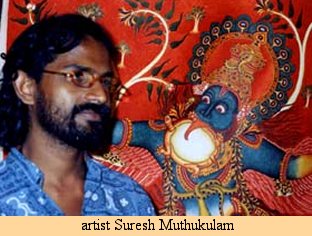
S.Suresh
Kumar, popularly known as artist Suresh Muthukulam
After schooling, he joined a painting
school in Haripad and fine-tuned his skills at a painting school in Mavelikara.
On successful completion of these courses, he joined a five year degree
course ‘Kerala tradition in murals’, an innovative 'Gurukula' tradition
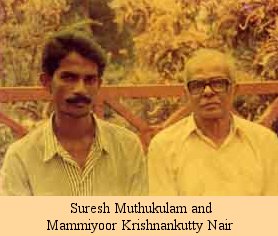
course initiated by the Guruvayur Devaswom. There he was fortunate to be
tutored under late Mammiyoor Krishnankutty Nair, a stalwart with in-depth
knowledge and creativity related to the art of Kerala mural creations.
Mammiyoor Aasan's tutelage was a turning
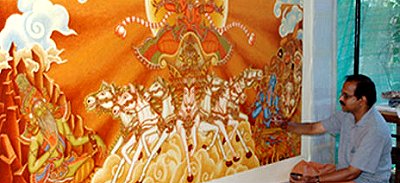
point in the career and life of Suresh. By then, he realized the way ahead
for him should be to choose the less trodden world of murals. He spent
more time on imbibing the essence and pulse of Kerala murals, which hinged
on themes related to history, epics and events from puranas. Later through
his works, he created a path of his own and took Kerala murals creations
to new levels and unknown themes, so far not experimented by the artists
in Kerala mural tradition.
Source: keralamurals.com/mural-paintings/ making-of-the-artist.htm |
Mural
artist, Naveen Bhaskar
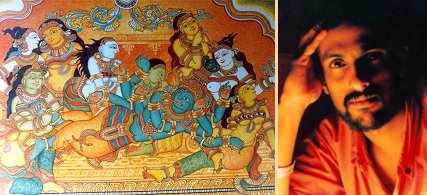
Naveen has a first-class National
Diploma in Mural Painting, from the Institute of Mural Painting, Guruvayur
Devaswom, Guruvayur.
View the paintings
|
Vinod
Kumar. N
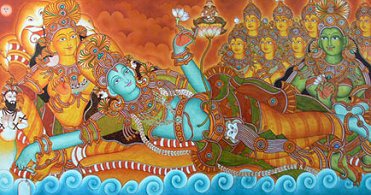
Vinod, hailing from God Own Country
(Kerala ), began his illustrious career in the world of creative imagination
as a visualizer in one of the most respected advertising agencies in India
at Bangalore. A Diploma Holder in Painting from the University College
of Fine Arts, in Davangree, Karnataka, he has enhanced his skill, with
a diploma in Software Applications.
|
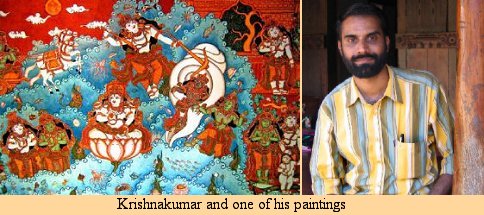
K.U. Krishnakumar, principal of
the Institute of Mural Painting in Guruvayoor, talks about this unique
art form.
The architecture in Kerala temples
follows the ‘panchamala’ pattern. The mandapam of the sanctum sanctorum,
or the Sreekovil as it is called, has five layers. The first layer is the
Bhoothamala, with carvings of ogres and demons. It also shows human beings
engaged in daily activities. The mrigamala shows animals foraging for food,
fighting with each other, mating and tending to their young. The pakshimala
is a depiction of birds, and the vanamala has scenes of the forest. Below
these four layers, and between the carved wooden pillars, is the space
that is covered by mural paintings - Chitramala.....
|
Anil's
Mural paintings
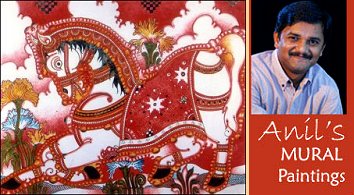
Anil V C is a dynamic, young artist
whose painting style has been inspired by the traditional mural style of
Kerala.
His paintings drawing inspiration
from the sacred texts or Dhyana Slokas are characterized by their line
accuracy, the adherence to color symbolism, elaborate ornamentations and
sensitive portrayal of emotions.
He is an active part of the new
genre artists involved in the revival of the traditional style mural art
form, while also adapting the mural style to modern minds and spaces.
|
|