PAINTINGS
CAVE PAINTINGS - AJANTA & ELLORA
April 2006
AJANTA
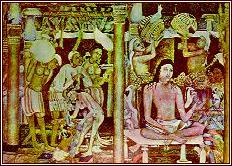
Illustration of a Prince - Cave 1
The Ajanta Caves carved out of volcanic
rock in the Maharashtra Plateau was not far off from the ancient trade
routes & attracted traders & pilgrims through whom the Ajanta art
style diffused as far as China & Japan. The Buddhist Monks employed
artists who turned the stone walls into picture books of Buddha's life
& teachings. These artists have portrayed the costumes, ornaments &
styles of the court life of their times.
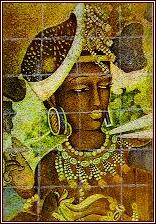
An Apsara - Cave 17
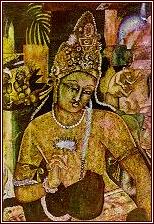
Bodhisattava Padmapani - Cave 1
The artists applied mud plaster in
two coats - the first was rough to fill in the pores of the rocks &
then a final coat of lime plaster over it. The painting was done in stages.
They drew the outline in red ochre, then applied the colours & renewed
the contours in brown, deep red or black.
The attenuated poses,
supple limbs, artistic features, a great variety of hair styles, all kinds
of ornaments & jewellery indicate skilled artisans.
In a mural in Cave 10, some 50 elephants
are painted in different poses bringing out the skill of the artist in
handling these bulky forms in all perspective views, with erected tails
& raised trunks, depicting sensed danger.
The styles of the later murals reveals
a merging of two streams of art, Satavahana of Andhra & Gupta art of
North India. This resulted in the classical style which had a far reaching
influence on all the paintings of the country for centuries to come.
A high degree of craftsmanship incorporating
all the rules laid down by ancient Indian treatises on painting & aesthetics
are evident. One cannot but notice the fluid, yet firm lines, long sweeping
brush strokes, outlining graceful contours, subtle gradation of the same
colour, highlighting nose, eyelids, lips & chin making the figures
emerge from the flat wall surface. Animals, birds, trees, flowers, architecture
are pictured with an eye to their beauty of form. Human emotions &
character are depicted with great understanding & skill - indignation,
greed, love & compassion.
Though not an art historian or
art critic, I was fascinated by Ajanta from my school days. I entered that
world through the then available literature. What was on offer, for the
most part, were scholarly works; there was a paucity of information for
the lay, interested reader. This is so even today. This and my continued
passionate interest in it are the only two reasons for my essay into this
enchanting world of sublime beauty.
- S. Swaminathan
the
many-splendoured delights of Ajanta, compiled
by Prof. Swaminathan
|
ELLORA
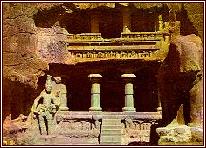
Mural
paintings in Ellora are found in 5 caves, but only in the Kailasa temple,
they are somewhat preserved. The paintings were done in two series - the
first, at the time of carving the caves & the subsequent series was
done several centuries later. The earlier paintings show Vishnu & Lakshmi
borne through the clouds by Garuda, with clouds in the background.
The sinewy figures have sharp features
& pointed noses. The protruding eye typical of the later Gujarathi
style appears for the first time in Ellora. In the subsequent series, the
main composition is that of a procession of Saiva holy men. The flying
Apsaras are graceful . Very few murals in the Jain temples are well preserved.
Information from "A History of Fine arts in India and the West " by Edith Tomory
Related Link
ajantacaves.com
|