Sage Bharata defines 'Music' as
the confluence or combination of Swara, Tala, & Pada - all in harmonious
blend. Sage Matanga defines 'Raga' as a combination of musical notes that
gives delight. a melody arrangement to project a definite mood, emotion
or feeling.
Brahma was the origin of music inspired
by Sama Veda. From one note, music progressed to three, then five &
crystallized in seven notes, the Sapta Swaras. Sapta Swaras are Shadja,
Rishaba, Gandhara, Madyama, Panchama, Daivata & Nishada. Swara is a
musical note. Swaras are reputed to have been inspired by sounds of birds
& animals such as :
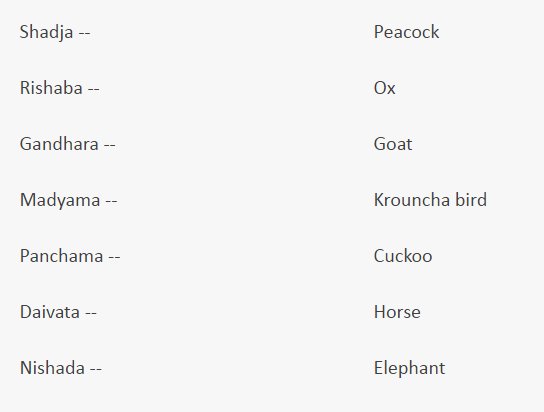
| Shadja -- |
Peacock |
| Rishaba -- |
Ox |
| Gandhara -- |
Goat |
| Madyama -- |
Krouncha bird |
| Panchama -- |
Cuckoo |
| Daivata -- |
Horse |
| Nishada -- |
Elephant |
Indian music has fundamentally been
a spiritual aid & the vehicle for the soul to realise & attain
the Universal Soul ( Paramatman). It lay stress on melody, harmony being
secondary though vital.
Corresponding Classification/Nomenclature
:
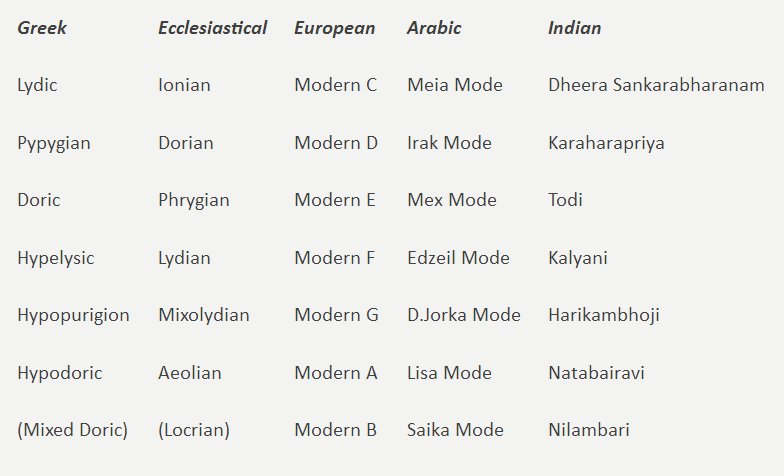
| Greek |
Ecclesiastical |
European |
Arabic |
Indian |
| Lydic |
Ionian |
Modern C |
Meia Mode |
Dheera Sankarabharanam |
| Pypygian |
Dorian |
Modern D |
Irak Mode |
Karaharapriya |
| Doric |
Phrygian |
Modern E |
Mex Mode |
Todi |
| Hypelysic |
Lydian |
Modern F |
Edzeil Mode |
Kalyani |
| Hypopurigion |
Mixolydian |
Modern G |
D.Jorka Mode |
Harikambhoji |
| Hypodoric |
Aeolian |
Modern A |
Lisa Mode |
Natabairavi |
| (Mixed Doric) |
(Locrian) |
Modern B |
Saika Mode |
Nilambari |
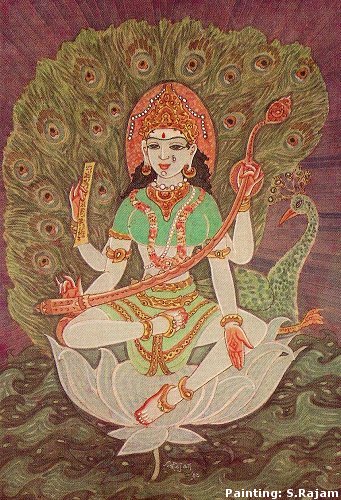
Saraswathi-the Goddess of Fine
Arts (Painting as found in Nepal)
|
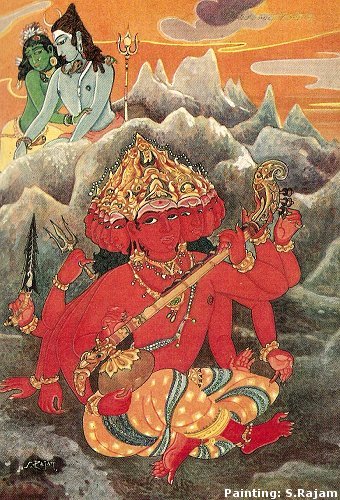
Ravana disturbed Siva &
Parvathi, while lifting Kailas and got entangled. Ravana with his
veena sings "SAMAGANAM" to get release from the pressure of Mount Kailas
over him.
|
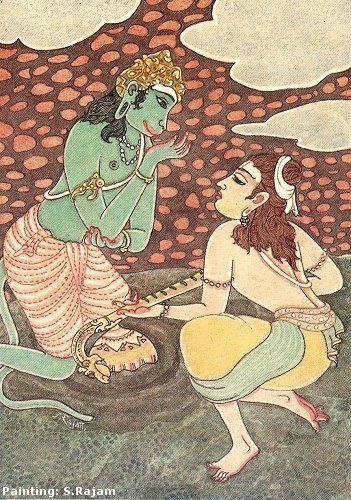
Sage Narada's vanity in music
is subdued by Anjaneya. Narada's main musical overtures failed, but
Anjaneya's oneness with music melted the surroundings and the veena got
stuck.
|
| Scale means stepwise
arrangement of notes which when successively invoked develop & provide
melody. Shadjam is basic or adhara swara which is the basis for the other
six notes. Madyama is pitchforked between two traids. Panchama denotes
the fifth place. When Sama Veda was recited ( Sama ganam), the spouse accompanied
on veena or flute.
From Pranavam emanates Satyajatam,
Vaamanam, Tatpurusham, Eesanam & Aghoram which are the five faces of
Lord Siva, from which the musical notes emanated & passed on to Posterity.
Siva taught Parvati, the prime Sishya & it was successively passed
on to Tumburu, Narada, Nandikeswara & Saraswati.
Initial instruments were :
Damaru of Siva, Flute of Krishna,
Conch of Vishnu, Drum of Nandi, Veena of Saraswati & Narada, Thambur
of Thumburu. Lord Buddha reinvigorated his teachings & message with
music on his Parivadini veena, made of gold, having 21 strings.
Sama Veda is well-known as musically
rendered. Rig Veda too is reputed to have been chanted once musically.
Thevaram by Appar, Sundarar & Sambandar and Divya Prabandam by Vaishnavite
Azhwars came up during 7-9th centuries. |
Saptha
Swaras
click icon to view in full screen mode
SimpleViewer requires JavaScript and the Flash Player.
Get Flash.
Gallery best viewed at 1024x768
If you are viewing at 800x600 or using an incompatible browser, pl click on the full screen icon at the top.
Sapthaswara:Paintings
by S Rajam based on details available from Sri Muthia Bhagavathar's "Sangeetha
Kalpa Drumam"
SHADJA :
Body plump, lotus like complexion, four faces, eight hands, white attire,
kumkum in forehead, has sword, sits on swan, gandarva wife, lives in Sambo
island, Agni saw this devata first.
RISHABA :
Slim body,green colour, three faces, six hands, peethambara dress. Blue
stone necklace, agaru in forehead. Kundam in his hand. Sits on lion, kinnara
wife, lives in Saha island. Brahma saw this devatha first.
GHANDARA :
Fat body, golden complexion, two faces, four hands, red attire, diamond
necklace, agaru in forehead, Dandam in hand, Ghanda Berunda bird as vehicle,
Yaksha wife. Lives in Kusa island. Moon saw this devatha first.
MADHYAMA :
Tall with four faces, eight hands, blue attire, lapis lazule(vaidooryam)
necklace, patharas on forehead, holds chakra, sits on deer, Kimpuru wife,
lives in Kroucha island. Vishnu saw him first.
PANCHAMA :
Well proportioned body. Complexion black, four faces, eight hands, red
clothes, emarald necklace, Gorojanam on forhead, pindi in his hand, Naga
wife, lives in Salmali island. Narada saw him first.
DAIVATHA :
Tall, blue body, three faces, six hands, pictured cloth worn by him, Gomethagam(sardonyx)
necklace, sandal on forehead, holding narasam, sits on parrot, Deva wife,
lives in Swetha island. Thumburu saw him first.
NISHADA :
Very fat, five coloured complxion, two faces, four hands, blue attire,
pushparaga(topaz) necklace, kadamba powder on his forehead, holding ankusam,
sits on Mynakam, Rakshasa wife, lives in Pushkara island. Thumburu saw
this devatha too.
The Melakartha Scheme of 72 ragas
has two versions. The reputed author of the Scheme, Venkatamakhi shaped
the Asampoorna Mela. Govindacharya brought out the Sampurna Melas. The
two versions have been followed by Muthuswami Dikshitar & Tyagaraja-Syama
Sastri respectively.
Seven swaras have twelve swara
divisions:
| Carnatic System |
Syllable |
Hindustani System |
Western |
| Shadja |
SA |
Shadj |
C |
| Suddha Ri |
R1 |
Komal Rishab |
D Flat Db |
| Chatusruti Ri |
R2 |
Thivra Rishab |
D |
| Sadarana GA |
G1 |
Komal GA |
E Flat Eb |
| Antara GA |
G2 |
Thivra GA |
E |
| Suddha MA |
M1 |
Komal MA |
F |
| Prati MA |
M2 |
Thivra MA |
F Sharp F+ |
| Panchama |
PA |
Pancham |
G |
| Suddha Da |
D1 |
Komal Da |
A Flat Ab |
| Chatusruti Da |
D2 |
Thivra Da |
A |
| Kaisiki NI |
N1 |
Komal NI |
B Flat Bb |
| KakaliNI |
N2 |
Thivra NI |
B |
SA & PA are constant. Others have
two levels(sthanas). Thus there exist twelve swara sthanas. Four more having
shades of other swaras - Suddha Gandharam, Shatsruti Rishaba, Suddha Nishada
& Shatsruti Dhaivata - make up a total of sixteen. 72 Sampoorna Ragas
having all seven swaras both in ascending (arohana) & descending (avarohana)
emerge as Mela ragas. Each mela has al the seven swaras but drafts varying
swarasthana formulations.
Each mela raga applied to permutations
& combinations of swara sthanas gives scope to 484 janya (sub) ragas.
72 mela ragas have thus a potential to give the colossal 34776 janya ragas.
Of course, this is only an arithmetical projection & not a melodic
feasibility.
Of 72 melas, the first 36 have M1
& the second 36 ave M2.
The Melakarta
chart
Composers
Music is associated with melody. Melody
with meaningful words (compositions) becomes a masterpiece.
"Vaagardha viva sampruktau vagartha
pratipattay
Jagatah pitarau vande parvati parameswaran"
says the very first verse of the
kavya 'Raghuvamsa' by the poet par excellence Kalidasa. It conveys that
a word & its meaning are indivisible and it is like the Divine unity
of Parvathi & Parameswaran. Such is the importance of meaning to a
word. And in India, where music is perceived as a means to salvation, we
find many compositions which excel in meaning, melody & technical efficiency.
We owe much to the composers, who, through their structured melodic patterns,
poetic phrases & technical brilliance have enriched Carnatic music.
SARANGADEVA
- MUSICOLOGIST : (13TH CENTURY) Details
Authored 'Sangita Ratnakara' the
greatest work after Bharata's 'Natya Sastra'. Hailed as "Nissanka", as
he was supreme in knowledge of music. 'Sangita' as referring to music alone
came to be used first by him. A magnificient musicologist.
JAYADEVA
- COMPOSER : (1101-1173)Details
Author of the Song Celestial 'Gita
Govindam' the first known composition in India specifying raga & tala.
Called 'The Indian Song of Songs', it has inspired composers, dance choreographers
& poets. The lady gracious behind Jayadeva's success was the eminent
Padmavati, his spouse, who danced to his singing.
PURANDARADASA
- Father of Carnatic Music System : (1484-1564) Details
A pioneer in bhakthi cult &
a brilliant, popular composer. His compositions inspired Tyagaraja &
others.
KSHETRAJNA
- Poet of Divine Love : (1610-1685) Details
His music & lyric share the
honours equally & it is in padams, Kshetrjna excelled. There is enchanting
beauty & exquisite finesse in his songs of dignified sringara. A great
composer who excelled in bringing out diverse emotions.
BHADRACHALA
RAMADASA - Composer : (1620-1680) Details
Religious bent of mind from boyhood.
Was Tahsildar at Bhadrachalam & he rebuilt the temple of Rama. Was
incarcerated at Golkonda. Divine will got his release. Exquisite songs
of Ramadasa are popular. He was the 'Mulapurusha' of harikatha sampradaya.
TYAGARAJA
- Fragrant gold of Carnatic Music : (1767-1847) Details
The most popular of Carnatic Music
Trinity. 'In devotion & religious fervour, he is like Purandara &
Ramadasa', in lyrical moods he takes a leaf off Kshetrajna; in the language
of Gods, he seems to beckon his contemporary Dikshitar & Sastri; in
dramatic composition, is like Narayana Tirtha & Merattur Venkutaramana
Bhagavathar. His adherence to sampradaya is supreme.
MUTHUSWAMI
DIKSHITAR - Architect of Raga forms : (1776-1835) Details
The compositions of Dikshitar are
rich in raga bhava full of gamakas & graces, beauty, majesty, mastery
& wisdom. A magnificient composer, vocalist & veena player, he
was all serenity & poise. One of the Carnatic Music Trinity.
SYAMA
SASTRI - Tala Prastara :(1762-1827) Details
One of the Carnatic Music Trinity,
his songs are noted for tala intricacies. 'The melodic form of his compositions
are strikingly original, unconventional & free.' Devi Kamakshi of Tanjore
was his patron deity.
SWATHI
TIRUNAL - Royal Composer : (1813-1846) Details
Proficient in many languages with
great talent in music, he was the Maharaja of Tiruvancore, a great patron
of arts. Lord Padmanabha of Travancore was his Ishta Devata.
THIRU GNANASAMBANDAR
- Divine Composer : (6th century)
While yet a baby was suckled by
Goddess. One of the four great Saivaite Apostles. His divine musical hymns
in Tamil are delightful & the lyric is magnificient.
THIRU NAVUKKARASAR(APPAR)
- Divine Composer : (6th century)
One of the prime apostles of Lord
Shiva. A life of fragrant devotion & service to humanity.
SUNDARAMURTHY
NAYANAR - Divine Composer : (8th century)
A romantic apostle of Lord Shiva,
his musical hyms form part of Thevaram along with those of Gnanasambandar
& Navukkarasar.
MANICKAVACHAKAR
:
One of the main four Nayanars of
Shiva. He exhorts all to 'Sing the ecstatic joy of the Lord soaked in graceful
raga; He shall bestow his grace in return.'
TALLAPAKA
ANNAMACHARYA - Architect of Devotional ecstacy : (1408-1503)
Annamacharya family was a fountain
of divine ecstacy which has dedicated a whole range of poems of madhura
bhakthi. 12,000 songs are engraved on copper plates to ensure against ravages
& insanity of nature & man. Lord Venkateswara of the Seven Hills
was his patron deity.
ARUNAGIRINATHAR
- Eminent Divine Poet : (c.1450A.D.)
The finest flower among Tamil composers,
devoted & dedicated. His composition 'Thiruppugazh' in praise of the
Lord 'is a vast ocean of intricate time measures'. An unrivalled Master
of Verse.
MUTHU THANDAVAR
- Fragrant Bhava exponent : (16th century)
Depth of theme, felicity of presentation,
simplicity of lyric underline his romantic poems. Lord Nataraja was his
destiny & patron. His padams, the delight of dancers, are a mine of
bhava, bhakthi & rasa.
UTHUKKADU
VENKATASUBBA AYYAR - Composer & Divine : (1700-1765)
His love of Lord Krishna was unparalleled
& his bhakthi for Muruga was non pareil. His songs are graceful &
soulful.
ARUNACHALA
KAVIRAYAR - Eminent Composer : (6th century)
'Rama Nataka Kirtanas', a pioneering
musical opera, enjoys simplicity of chaste language, easy-pace, flowing
presentation, mastery & versatality. It was released at the temple
of Sri Ranganatha, Srirangam in 1771 A.D. His songs were set to tune by
Sattanadapuram Venkatarama Ayyar & Kodandarama Ayyar.
GOPLALAKRISHNA
BHARATI - Father of Tamil Music Renaissance : (1811-1881)
Author of the pioneering socio-spiritual
musical opera 'Nandanar', Bharati led a unique life of excellence &
mastery of spirit over matter. Has covered the whole gamut of musical compositions.
Lord Nataraja, the Cosmic Dancer, was his Ishta Devata. He was an eminent
musical discourser too.
SRI PERIYALWAR
: (C.700-750)
Vishnuchitta, as Periyalwar was
called before he was included in the apostolic order, brought up Sri Andal
full of love & affection but had to part with her when the Lord took
her as spouse.
SRI ANDAL
: (716-732)
Divine origin, glamorous life, spiritual
union mark the verdant life of Sri Andal who had left to posterity the
enchanting songs called "Thiruppavai" & "Nachiar Thirumozhi".
THIRUMANGAI
AZHWAR) : (716-821/750-800)
'The effulgent lamp that shuts out
darkness in mind', Thirumangai Azhwar fulfills all the demands of modern
fiction. He had covered the largest number of temples among Vaishnavaite
Apostles with pilgrimage & songs.
Some
Prominent Terms in Musical Parlance
RAGAM
:Free improvisation of pure melody(alapana) based on swaras
without rhythm in successive melodic phases, quite within the stipulated
framework of the raga with its arohana & avarohana, i.e., ascending
& descending scales. Each raga has all the seven or six or five notes
in varying combinations - called sampoorna, audava-shadava, etc & enjoys
a distinct 'raga swarupa'. Carnatic music enjoys the most systematised
raga-melodic structures. Hence called "Ranjayatee iti ragah".
TANA
:Without percussive help, rhythic pulses brought out delineating
the various phases & tempos, the fineness and beauty of a raga to display
& portray its panoramic potential. Veena is the ideal instrument for
tana since all its seven strings blend to give a harmonius nada(sound)
in the crescendo.
SWARA
KALPANA :Improvised swara permutations as are appropriate
to each raga. Solfa syllables alone are used to elaborate & pleasing
combinations depend on the expertise of the artiste. Raga alapana has no
rhythm but swara kalpana is subjected to the strict discipline of rhythm(tala)
TALA
:Rhythm. Time-cycle containign one or more sub-time measures.
There are 128 talas. Each is a rhythmic arrangement of beats, etc., in
cycles.
PALLAVI
:The first section of a kriti or kirtan, which has normally
a pallavi, anupallavi & charanam. A few have 'samashti charanams' where
there is no distict anupallavi.
Pallavi also represents
the distinct manodharmic sangita using a short phrase or idiom & giving
full scope to exposition of raga-tala intricacies, swara kalpana, etc.
This type of special rendition demands a high level of expertise
RAGAMALIKA
:A garland of ragas with or without lyrics.
PADA,
JAVALI :Modern padams depict musical forms best suited
to bring out the infinite captivating graces. Javalis slightly differ from
padas in its erotic content.
TILLANA
:A composition with jatis, brisk in tempo interspersed with
swaras, katos and lyrics. Often in middle & fast tempos. Best suited
to dances to whip up tempo after the sublime, padas.
ALAPANA
:Extempore, innovative, creative improvisation of raga.
ABHYASAGHANAM
:Practising music
AROHANA
:Ascending order of notes - sa, ri, ga, ma, pa, da, ni either
in full, or with omissions or in jumbled series according to the prescribed
notes of each raga.
AVAROHANAM
:Same as in arohana but in descending order. If arohana
takes the rendition uphill, avarohana brings it back downhill. Taken together,
raga swaroopa or shape is evolved.
BANI
:Style of rendition.
BHAVA
:Emotion, feeling, the soul of lyric or raga.
CHITTASWARA
:Solfa syllables (swaras) pre-set by composer as distinct
from swara prastara, which is improvised. Chittaswara is ornamentation
to bring out the innate beauty of raga in the context of the flow of the
song.
MANGALAM
:Traditional end of concert or chorus - a propitious finale.
NIRAVAL
:Niraval is phrasing, developing and expounding the lyric
bringing out the subtelities & beauties, and variations of the raga.
VADI
:Most important note of a raga.
VAKRA
:Jumbled notes in arohana or avarohana.
VARJA
:Notes omitted in arohana or avarohana which conduces individual
raga swarupah.
LAKSHANA
GITAM :Song which illustrates or portrays the basic
features of a raga.
VARNAM
:Composition with limited words & maximum of notes to
bring out raga lakshana & raga bhava.
SAPTA
TALAS :Druva, Matya, Rupaka, Jampai, Triputa, Ata &
Eka talas(7).
SHADANGAS
:Laghu, Druta, Anudrata, Guru, Pluta & Kakapada(6) -
which distinguish individual talas.
LAGHU
:One beat & counting or time-measures with fingers -
as many as is fixed for each tala.
DRUTA
:Beat of the hand & visarjita or turning it - 2 aksharakalas.
ANUDRUTA
:Beat of the hand alone - 1 aksharakala.
AKSHARAKALA
:Unit measure of talas. Thus,
Druva tala has 14 aksharas.
Matya tala has 10 aksharas.
Rupaka tala has 6 aksharas.
Jampai tala has 10 aksharas.
Triputa tala has 7 aksharas.
Ata tala has 14 aksharas.
Eka tala has 14 aksharas.
AVARTA
:One full cycle of any tala comprising one or more of the
shadangas having the respective aksharakala.
VAGGEYAKARA
:One who composes & sings his own creations.
From Musings on Music - a handy
music diary for writing notation by S.Rajam
Text by S.Rajam, Text assisted
by "Garland" Rajagopalan, Illustration by S.Rajam
|