MUSIC
Profiles of Artistes, Composers, Musicologists
Unless otherwise specified, the profiles in this section are
from
The Garland, Another Garland, Yet Another Garland and The
Fragrant Garland by Mr.N.Rajagopalan
B.RAJAM
AYYAR - VOCALIST.............(b. July 15, 1922)
Born
at Pavattakudi (near Ramnad), of Balasubramania Ayyar and Lakshmi Ammal,
Rajam Ayyar had his initial training under Tirugokarnam Subbiah Bhagavathar
and Vidwan Ganapathy Ayyar of Kunnakudi, a Gottuvadyam and Jalatarangam
artiste. After five years of intensive training, he took up gurukula under
Ariyakudi Ramanuja Ayyangar for a decade of study and apprenticeship. He
is the leading discciple and exponent of the style of Ramanuja Ayyangar.
Soft
spoken, religious and studious habits, he has deep respect for and faith
in sampradaya music. His personal charm, modesty and restraint are part
of his personality. His long association with Ariyakudi Ramanuja Ayyangar
enriched his repertoire. He further augmented his repertoire of Muthuswami
Dikshitar kritis by taking special lessons from Sangita Kalanidhi T.L.Venkatarama
Ayyar.
The
period also witnessed his setting tunes and rhythm to all the songs of
'Tiruppavai' of Sri Andal, a large number of 'Rama Natakam' songs of Arunachala
Kavirayar and others and publishing them. An acknowledged musicologist,
he brought out the tamil edition of the celebrated treatise, 'Sangita Sampradaya
Pradarsini' for the Music Academy, Madras.
"His
concerts are noted for the sustained interest they acquire from the tana
varna to the lighter pieces bringing out the excellence in composition
and musical content. The main characteristics of his presentation is his
devoted integrity and fidelity to the compositions and the composers. A
good musician of wide experience, charm and rich tradition, Rajam Ayyar
is a model teacher. He is one of the top musicians who takes to Tamil songs
liberally thanks to the special assignments he had undertaken. In 1942,
he started his career with a concert at the Tyagaraja Aradhana at Tiruvaiyaru.
From 1943 for 4 years he was music tutor to members of the royal family
at Travancore. His advent at Madras started in 1956 with a performance
at the Jagannadha Bhaktha Sabha, Egmore, which was then a favourite haunt
for classical artistes of repute. His younger brother, Krishnamoorthy learnt
music under him and got vidwan title at the College of Carnatic Music at
Madras. They used to give performances together too. He has served on selection
panels of Madras and Delhi Universities, is a member of the Expert Committee
of the Music Academy, Madras and has given special recordings and demonstrations.
He
has been honoured and felicitated by various institutions like :
Kalaimamani
from Tamil Nadu Eyal Isai Nataka Mandram in 1981
Swara
Vilas from Sursingar Samsad, Bombay
Sangeetha
Kala Sikhamani from Indian Fine Arts Society
Government
of India Fellowship 1984-86
Sangeetha
Nataka Academy Award in 1986
Sangeetha
Kalanidhi from Madras Music Academy in 1987
S.RAJAM
- VOCALIST & ARTIST.............(b.February 10, 1919)
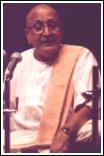
The
portraits of eminent composers and musicians that adorn the walls of the
Music Academy, Madras as well as some journals are the creations of S.Rajam.
His paintings have come out in book form also (Navagraha and others of
Kalaimagal publications).
'It
is vital to understand the meaning and bhava of a composition to render
the song with insight or the dance with emotional presentation.'
Through
his 'Chitranjali', S.Rajam designs and produces letter-pads illustrating
and depicting the meaning and bhava of songs to secure that understanding
and appreciation of the bhava. The vocalist is a degree holder in painting
from the School of Arts, Madras after six years of training. He has done
a large number of portrait paintings like Vakkeyakaras of Indian music.
Son
of V.Sundaram Ayyar and Chellammal, S.Rajam was born at Madurai and hails
from the family of Srivanchiam Subbarama Ayyar. Had his training in music
under a galaxy of stalwarts like Ambi Dikshitar, Ariyakudi Ramanuja Ayyangar,
Papanasam Sivan and Madurai Mani Ayyar from 1929 to 1941. Since 1934, he
has been giving concerts all over India and abroad. Has been the recipient
of medals from the Music Academy, etc. and the title 'Isai Kadal' from
the Tamil Sangam, Karaikudi in 1988. Was Music Supervisor in the All India
Radio for thirty-five years till retirement in 1979 and took interest in
popularising Tirukkural. Was on the All India Radio panel and is now on
the Experts Committee, Music Academy, in the proceedings of which he takes
keen interest.
Has
been devoting much attention to the popularisation of the songs of Koteeswara
Ayyar and songs in rare ragas. Has a number of disciples. The veena maestro,
S.Balachander is a brother of Rajam. His paintings of the Carnatic Trinity
have been appropriately unveiled at the temple of Sri Kamakshi by Sri Jayendra
Saraswathi, Sankaracharya of Kanchi-Kamakoti Peetam.
KUMBAKONAM
RAJAMANICKAM PILLAI
RENOWNED
VIOLINIST.............(August 5, 1898-1970)
Rajamanickam
Pillai was born at Alangudi near Nidamangalam, of Kamalathammal of Isai
Velalar sect. The mother was very much interested in developing the musical
talents of her son. He had training in vocal music under Nagaswaram Kandaswami
Pillai, Tiruvisanallur Pallavi Narayanaswami Ayyar and Pandanallur Chinnaswami
Pillai and violin under Tirukodikaval Ramaswami Ayyar for four years. He
stopped vocal music under advice as violin suited his genius. The disciple
was devoted to his guru and the master too had not spared the rod. In his
musical advancement, Rajamanickam had the advice of Kumbakonam Flute Nagaraja
Rao and Umayalpuram Swaminatha Ayyar, two senior vidwans.
He
was a classicist. He never indulged in acrobatics or sudden thrusts and
flashes. Bred on the banks of the river Cauvery, his play imitated its
majesty while it is brimful and in full flow. It was dignified, masterly,
chaste and satisfying. Violin in his hands found harmony and established
close identify with the musician and rarely sought to carve out any distinct
identity. The success of the concert was his concern. He was pleasing in
manners, unostentatious on the stage and magnificient in play. Had a good
personality. He would play for juniors also. He had played for all top
artistes. Rajamanickam Pillai was honoured at the Courts of Ramnad, Cochin,
Ettayapuram, Travancore and Mysore. He was Asthana Vidwan at Travancore
in 1940 and at Ettayapuram in 1942. He had been the recipient of Sangita
Natak Academy Award in 1959, Isai Perarignar from the Tamil Isai Sangham
and Sangita Kalanidhi from the Music Academy in 1948. Once he got an elephant
as a gift and donated it to Sri Adi Kumbheswara Temple, Kumbakonam. His
disciples included M.M.Dandapani Desikar and Govindaraja Pillai.
T.N.RAJARATHINAM
- NAGASWARAM WIZARD.............(1898-1956)
The
sound, melody and high potency Carnatic music emanating from T.N.Rajarathinam's
nagaswaram acted as anaesthesia, lulled pain, lullabied the child, silenced
the angry and raised even the lay and uninitiated to the world of inventive,
ecstatic and enthralling music.
He
revolutionised the art by taking tambur and mridangam in lieu of the drone
'othu' and tavil. Rajarathinam hailed from Tiruvaduthurai. Son of Kuppuswami
Pillai, he had his training under his uncle Tirumarugal Natesa Pillai in
nagaswaram, Tirukodikaval Krishna Ayyar in vocal music and Tiruvavaduthurai
Markandam Pillai in nagaswaram. Natesa Pillai, a brilliant nagaswara vidwan
adopted him. Thus his training under the stalwarts helped Rajarathinam
much. He was innovative, adventurous and adroit. He had graced not only
'Todi' but had taken 'Shanmugapriya' and certain others to
sublime heights of fragrant improvisation.
He
was given the Presidential Award in 1952. He has acted as hero in the film
'Kavi Kalamegam'. He has given several disc recordings which still rule
the market. They convey the rich, captivating melody, the wizardry of his
improvisation and the unsurpassable beauty and charm of his rendition.
He did not relish suggestions and requests during concerts. At Rameswaram
someone requested for 'magudi'. The vidwan handed over the nagaswaram to
the party advising him to render it himself! He is among the illustrious
artistes whose memory shall always be cherished. He was a wizard then and
is a legend now.
SANGITA
SIROMANI M.D.RAMANATHAN
VOCALIST/PEDAGOGUE.............(May
20 1923 - April 27 1984)
A
classicist and gentleman par excellence, M.D.Ramanathan was one
of the best examples of a true devotee to guru. He was totally devoted
to Tiger Varadachariar, his teacher that it extended even to the imitation
of his stage mannerisms! It used to be said that the guru-sishya relationship
between the Tiger and the Cub was so noble that the student inherited even
the squint in the eyes.
Born
at Manjapara (Palghat) in Kerala, of Devesa Bhagavathar, a local musician,
he had his initial musical training under his father. Simultaneously he
completed his B.Sc. in Physics from the Victoria College, Palghat. He secured
graduation in music from Kalakshetra and got his Sangita Siromani. Actually
he constituted a 'single student first batch' for that course. Tiger used
to refer to him as 'thief' for robbing him of all knowledge in music! A
lifting recognition of merit in a devoted pupil. He was a professor in
the same institution to the last. His voice was suited to slow tempo (vilambakala)
and he developed his own style, which was sober, serene and effective.
He was at his best in ragas like Sahana, Yadukula-kamboji, Sri, Kedaram,
etc. Adverting to his slow tempo, an admirer is reported to have mentioned
that blood pressure got to the normal by constantly hearing him and called
him a music therapist. As a teacher, he was strict and very attentive.
He
was also a composer in Sanskrit, Telugu and Tamil and his deep faith in
spiritualism found vent in his songs like 'Parama Krupanidhe' and
'Sambho Mahadeva' on Sri Kapaleeswaraswami, Mylapore. His 'Sagara
Sayana' (Bagheswari) is an important kriti.
He
was honoured with
the
confernment of 'Padma Sri' in 1974
Sangeet
Natak Academy Award in 1975
Sangeetha
Kala Sikhamani by the Indian Fine Arts Society.
A
good musician and a sincere teacher, he was held in respect.
Dr.S.RAMANATHAN
VOCALIST
& MUSICOLOGIST.............(April 8 1917-March 19 1985)
'Dr.S.Ramanathan
is the first artiste who shone both as a musicologist and a performing
musician. Born at Tirukoilur (Velavanur), of Subramania Sastri and
Pattammal, he started his tuitions in music at the age of seven with Tirukoilur
Ramudu Bhagavathar and Manalurpettai Subramanya Dikshitar. Later,
he continued his training under such stalwarts as Thanjavur Ponniah Pillai,
Tiruvaiyaru Sabhesa Ayyar, Sathur Krishna Ayyangar, Madurai Subramania
Ayyar and Tiger Varadachariar at the Annamalai University. He obtained
the University diploma 'Sangita Bhooshanam'. He did not stop.
His quest for learning led to intensive coaching from Valadi Krishna Ayyar
and Devakottai Narayana Ayyangar. The silent, sincere and patient
vidwan has expressed his gratitude also to Chidambaram Nagaswaram Vaidyanatha
Pillai, Karaikudi Veena Brothers and Anayampatti Jalatarangam Subba Ayyar
for enriching his musical knowledge. Nobody could boast of a larger
list of distinguished tutors and no wonder, he was rich in music and rich
in musical science and theory.
His
versatility extended to research besides vocal and veena. The Tamil
Nadu Sangita Nataka Academy took him as a researcher. He read his
first paper on 'Musical Scales described in Silappadikaram' at the
Music Academy, Madras in 1956. With B.Rajam Ayyar, he was connected
with the Tamil version of 'Sangita Sampradaya Pradarsini' of Subbarama
Dikshitar, the greatest compendium in Carnatic music. It was as a
teacher, he earned wide popularity and fame. He tried to infuse the
influences of other cultures by learning Western methods of teaching and
had held teaching assignments in USA, Taiwan and Malaysia, besides India.
He had composed songs like 'Aadum Arase' (Surati). His concerts
were noted for clasical emphasis, chaste music and freedom from acrobatics.
Had a soft voice, a penchant for emphasis on meaningful rendering of songs
with bhava highlighting the sahitya (text) - sangita (music) nexus, blend
and significance. Personally, he was soft, mild and cultured carrying
an immense load of vast knowledge and varied experience without a tinge
of show or exhibitionism. He passed away after he heard Muthuswami
Dikshitar's 'Abhayambhikayam' (Sahana).
Publications
:
Silappadikaram
Isai Nunukkam
Masterpieces
of Syama Sastri
Sangita
Sampradaya Pradarsini - Joint effort in transalation.
He
has been the recipient of honours such as :
Isai
Perarignar from Tamil Isai Sangam, 1981
Swati
Thilakam from Swati Tirunal Sangeetha Sabha in 1984
Sangita
Kalanidhi from Music Academy in 1985
Sangita
Kala Sagara from Visakha Music Academy in 1987
Doctor
Ramanathan had given hundreds of concerts and musical discourses (Kalakshepams)
in addition to training a large number of students in music.
Prof.
V. RAMARATHNAM.............(b. 1917)
Prof.
V. Ramarathnam was born in Chittoor, Andra Pradesh in 1917. After his preliminary
education he moved to Bangalore and received training in vocal music under
Ganakala Sindhu D. Subbaramiah and Palghat Someshwara Bhagavathar. He later
moved to Mysore and underwent rigorous gurukula training in vocal music
for ten years under the legendary violinist Sangeetha Ratna Mysore T. Chowdiah.
Ramarathnam's musical knowledge, repertoire and delivery, attained breadth
and mastery through close association and interactions with stalwarts like
Mysore Vasudevachar, Ariyakudi Ramanuja Iyengar, Maharajapuram Viswanatha
Iyer , Chembai Vaidyanatha Bhagavathar and Alathoor Srinivasa Iyer.
Prof.
Ramarathnam's career as a performing artist and teacher, spanned over four
decades starting in 1945 as the first Vice-Prinicpal, Ayyanar College of
Music in Mysore, started by T. Chowdiah. He then was chosen as the Professor
of Music and First Principal of the the University College of Music and
Dance, University of Mysore in 1965. Following his retirement in 1977,
the University Grants Commission, Govt. of India invited Prof. Ramarathnam
to continue his service as Emeritus professor, which he served until 1980.
His research work during this period on the "Contribution and Patronage
of Mysore Wodeyars to Carnatic Music" is considered to be an authoritative
record. This work was recently published by Government of Karnataka, Kannada
Book Authority. He has served as the Chairman of the Board of Graduate
and Post Graduate studies in music, University of Mysore, Chairman, Board
of Examiners University of Kerala, and as a member of the board of studies
at Venkateswara University, Tirupathi. Prof. Ramarathnam has trained hundreds
of students and has also guided doctoral students in music. The Mysore
University Press has published ten books authored by him on the theory
and practical aspects of Carnatic music. Many of these books are being
used currently for undergraduate and graduate instruction in music.
Prof.
V. Ramarathnam is an 'A' class artist of All India Radio and has been giving
concerts for over fifty years at several AIR centers and throughout the
country as well as United States. As a vocalist Prof. Ramarathnam's greatest
asset is his style of rendering, that is stately, slow, reposeful, bounding
in languorous tonal elongations and immersed in spiritually deep and concentrated
expression. Listeners are made to feel and become aware of his mode, his
means and his medium, coupled with his impelling motivation and technique
in attaining the cherished goal with minimal use of paraphernalia.
One his memorable concerts was a Madras Music Academy concert in 1958,
to an audience filled with legends such as Chembai, Maharajapuram Vishwanatha
Iyer, Ariyakudi, (to name a few), when his guru Chowdiah received the academy's
coveted Sangeetha Kalanidhi Award He has performed to the accompaniment
of great artists including his own guru T. Chowdiah,Govindaswamy Naickar,
Prof. T.N. Krishnan, Chalukudi Narayanaswamy, M. Chandrashekaran, etc.
on violin and Palghat T.S. Mani Iyer, Vellore ,Ramabhadran, T.K. Murthy,
Umayalapuram Sivaraman, Tanjore Upendran, Prof. Trichy Sankaran, Guruvayur
Dorai , Alangudi Ramachandran etc on the mridangam.
Prof.
Ramarathnam has received deep appreciation and recognition from the legends
of his time for his scholarship in all aspects of music. He alo received
a number of titles. He was conferred the title of Sangeetha Kala Rathna
when he presided over the 14th Musician Conference under the auspices of
the Bangalore Gayana Samaja in 1983. He is also the recipient of the Karnataka
State Sangeetha Nritya Academy award, Karnataka Kalathilaka in 1986, Sangeetha
Rathna Mysore T. Chowdiah Memorial Award for his long lasting contribution
to music, in 1994-95, as well as recognition from many leading sabhas.
Motivated
by Poet Laurete Kuvempu, Prof. Ramarathnam composed his first krithi "Karunisu
Pramatha Ganapathe" in the raga Todi set to Rupaka tala, following which
he composed more than 25 keerthanas and thillanas in Sanskrit, Kannada,
and Telugu with the swanama mudra, 'rama'. Many of his students such as
Prof. T.S. Ramaa, Uma Prasanna Sukanya Prabhakar, Dr. R.N. Sreelatha, Dr.
T.N. Padma , Nagamani Srinath, Dr. K. Vageesh (Director of Carnatic Music,
All India Radio, New Delhi) are performing artists of repute, professors
of music, and are serving AIR centers and universities.
RAMNAD
RAGHAVAN - MRIDANGIST.............(b. June 19, 1927)
Born
in Madurai of P.Vaidyanatha Ayyar of Kooniyur, Tirunelveli district and
Brhannayaki, he had is musical training from his brothers Lakshminaraynan
-violinist, Krishnan - vocalist & Sankarasivam who had moulded many
a musician and percussioist to fame.
There
was not much music in the family to claim hereditary influence except a
musical mother. Like the eastern sky, there was a flash; the musical sun
smiles upon the family of Raghavan with no twilight to mention to present
a vocalist, violinists and percussionists. Raghavan was with his brother
Lakshminarayanan at Jaffna for about nine years and the itinery of the
family took him to other places like Chennai. With a prominent mridangist
in brother Eswaran and vocal and instrumental artistes in other brothers,
Raghavan, the youngest of the musical brothers enjoyed ample scope for
practice and soon shaped into a competent percussionist. He has provided
able percussive accompaniment, besides Ramnad Krishnan, to most of the
stalwarts with merit and artistry at sabhas, All India Radio, etc., Raghavan
took prominnt part in organising the Tyagaraja Festival at Cleveland during
1978-1992 and left it only in 1993. He has been honoured by the Carnatic
Music Association of North America in 1993.
A
good artiste, Raghavan is giving earnest training to scores of foreign
students now. A cultural ambassador to USA.
|
|
|