ARTS & CRAFTS
TRADITIONAL CUSTOMS AND PRACTICES
August 2009
Kalam,
ritual ground paintings of Kerala
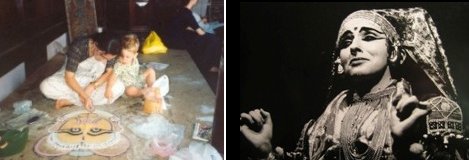
Chantal Jumel learnt from Sri Parameswara
Kurup, a ritual painter attached to the prestigious temple of Ambalapuzha
in Kerala, the technique and spirit of kalam ground painting. Chantal
also studied Kathakali and Mohini - Attam during her visit to Kerala.
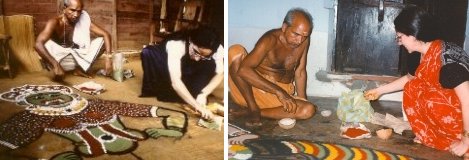
In Kerala, the tradition of ephemeral painting is
called "Kalam-Eluttu Pattu" literally "to draw and to sing the kalam".
Almost invisible, the paintings of Kerala or kalam do not expose
themselves to the morning walker's gaze like the kôlam. They are
mostly drawn in the intimacy of the house and focus the attention of the
family or the devotees when they are represented within the precincts
of the temples.
In Kerala,
there are communities of ritual painters whose function consists in drawing
in temples or in houses, temporary paintings with mineral and vegetable
powders called yantra, mandala or kalam to welcome and appease the invoked
divinity.
The latest ones are generally anthropomorphic
images and the officiating painter in charge of the kalam carries out the
form of the divine which is offered to experience through sight and touch.
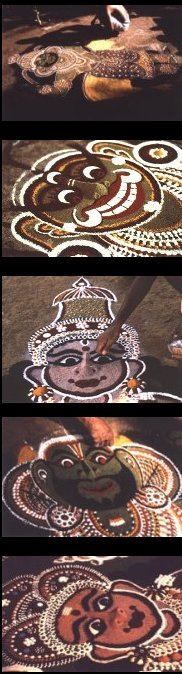 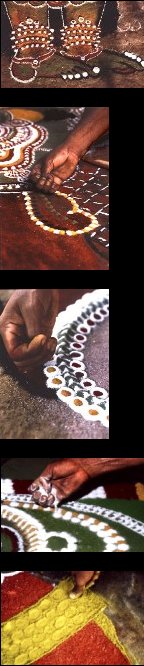
These paintings realized by means
of mineral and vegetable powders are used in ceremonies in homage to the
Goddess, to the snakes and to other divinities of the Indian pantheon.
They are also elaborated with a therapeutic
purpose because in the mind of an Indian villager, diseases, barrenness
and premature death were and are still attributed to supernatural powers
or to the grabbing "spirits" which it is advisable to cajole or to annihilate
by incantations, songs and symbolic gestures of the hands (mudra).
These ephemeral drawings do not result
from the imagination of the priest; they are dictated by precise rules
which include forms and colours. To understand these ceremonial paintings
it is necessary to show them in connection with the context.
The iconography relates to the myths,
to the legends and to the rules memorized and passed on from one generation
to another generation. The learning and the transmission of these ritual
paintings take place within the different traditions.
Boys assist their fathers, prepare
and mix the powders, fill in the design with the appropriate colours and
observe the sketching until they are considered worthy to draw themselves.
Text & photos shared by Chantal Jumel
chantal-jumel-kolam-kalam.com/
|
|
|